
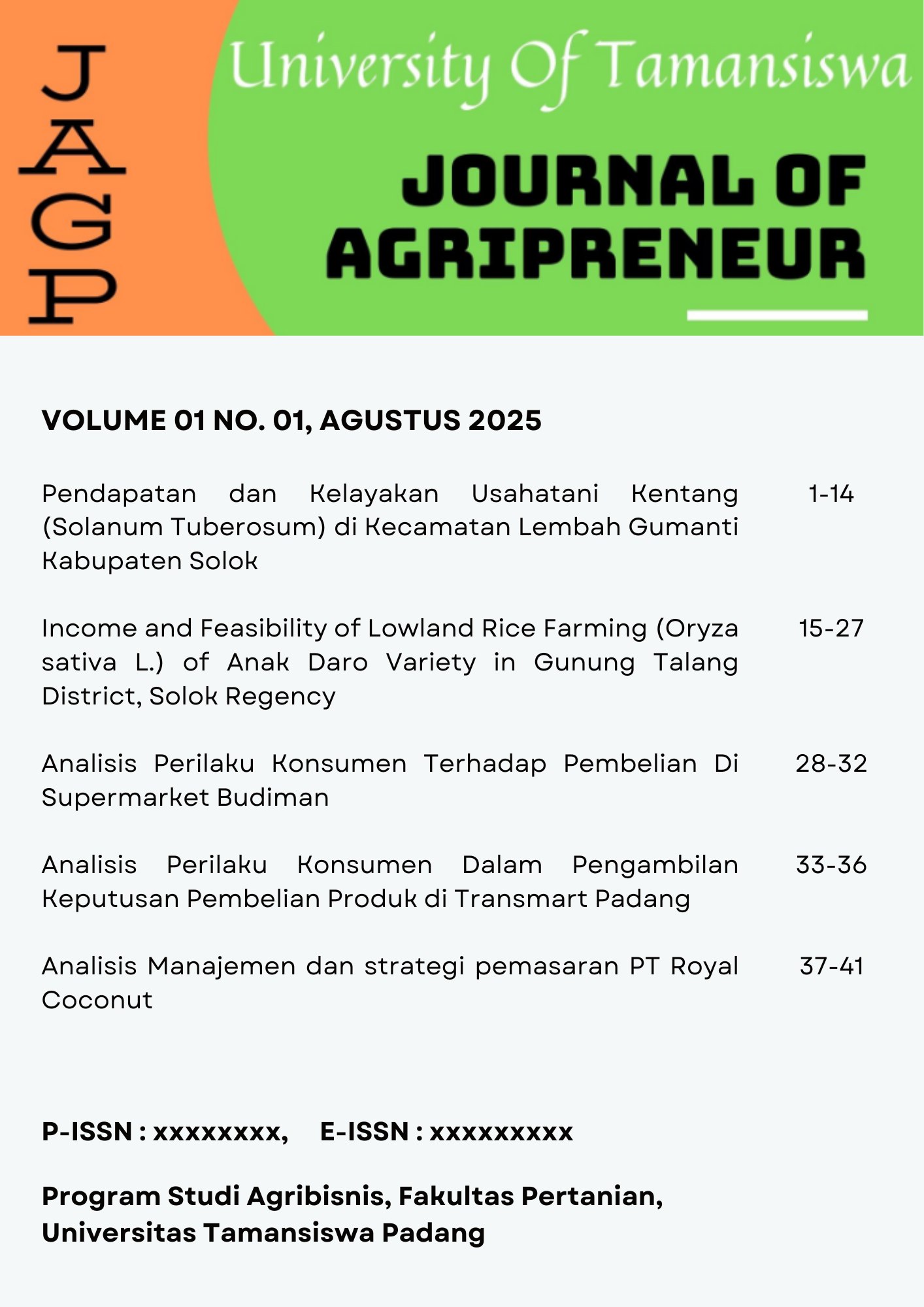
Income and Feasibility of Lowland Rice Farming (Oryza sativa L.) of Anak Daro Variety in Gunung Talang District, Solok Regency
Article Sidebar
Main Article Content
Abstract
The productivity of lowland rice in Gunung Talang District increased from 2016-2017 and after that continued to decline until 2020. The decline in productivity in Gunung Talang District was caused by pest attacks (planthoppers and golden snails), disease, fluctuating fertilizer prices and land conversion which had an effect on productivity. This research aims to describe the characteristics of lowland rice farmers of the Anak Daro variety, calculate the income of lowland rice farming of the Anak Daro variety, and analyze the feasibility of farming lowland rice of the Anak Daro variety in Gunung Talang District. This research uses quantitative methods with a descriptive approach. The research sample consisted of 30 farmers selected by purposive sampling. Data were analyzed using income analysis methods and farming feasibility analysis with R/C and B/C ratios and Break Even Point (BEP) analysis. The research results show that the average income received by lowland rice farmers in Gunung Talang District shows significant profits. With an average total cash income of IDR 6,950,082.05 per ton and an average total income of IDR 5,084,780.93 per ton. The biggest costs are for household labor and inorganic fertilizers, but with good efficiency, farmers can achieve profitable results. The R/C value recorded at 1.99 shows that lowland rice farming in Gunung Talang District is very feasible and profitable. Every Rp. 1 spent by farmers generates Rp. 1.99, which represents a significant economic surplus. The B/C Ratio value of 1.35 shows that this lowland rice farming business is financially feasible, with a surplus of 35% of the total costs incurred. BEP analysis shows that production higher than BEP (1,199.04 kg) indicates good production efficiency, with a selling price higher than the BEP price (Rp. 2,291.10/kg), which further strengthens farmers' profits.
Article Details

This work is licensed under a Creative Commons Attribution-NonCommercial-ShareAlike 4.0 International License.
References
Jember: Universitas Jember.
Astuti. 2013. Analisis Pendapatan Usahatani Padi Sawah. Jurnal Agribisnis, 34-40. Astuti. 2013. Analisis Pendapatan Ushatani Padi Sawah Di Kecamatan Kaway XVI Kabupaten Aceh Barat. 30-47.
Ayatul Fauzi, I. A. 2017. Pengaruh Faktor-Faktor Produksi Terhadap Hasil Pada Usahatani
Barat, B. S. 2020. Retrieved From BPS Sumatera Barat : Htpps://Sumbar.Bps.Go.Id Dennis Reynhard Lagebada, E. S. 2017. Analisis Pendapatan Dan Kelayakan Usahatani
Fathorozi, R. 2012. Model Analisis Ekonomika Pertanian. Makasar: Badan Penerbit UNM.
Fatmawati, L. M. 2013. Analisis Pendapatan Petani Padi Di Desa Teep Kecamatan Langowan Timur. Jurnal Riset Ekonomi, 45-51.
G, S. U. 2008. Hasil Simulasi Uji Buss Dan Identifikasi Varietas . Kerjasama Balitsa .
Hamid, A. 2016. Analisis Pendapatan Petani Padi Sawah Di Kecamatan Woyla Kabupaten Aceh Barat. Jurnal Agribisnis, 89-97.
Hesti, M. 2018. Analisis Produksi Dan Pendapatan Usaha Tani Padi Sawah Desa. Jurnal Agribisnis.
Ilma, D. S. 2020. Analisis Usahatani Padi Sawah Di Kecamatan Bangkinang Kabupaten Kampar. Jurnal Dinamika Pertanian, 91-98.
Made, A. R. 2013. Analisis Pendapatan Dan Kelayakan Usahatani Padi Sawah Di Subak Baturiri Desa Balinggi Kecamatan Balinggi Kabupaten Parigi Moutong. E-J. Agroteknis, 166-172.
Mamondol, M. R. 2016. Analisis Kelayakan Ekonomi Usahatani Padi Sawah Di Kecamatan Pamona Puselemba. Jurnal Envira, 67-70.
Matheus Frynardo Keukama, I. N. 2017. Analisis Pendapatan Usahatani Padi Varietas Ciherang Dengan Menggunakan Sistem Tanam Legowo Jajar 2:1 (Studi Kasus Di Subak Sengempel, Desa Bongkasa, Kecamatan Abiansemal, Kabupaten Badung). E-Jurnal Agribisnis Dan Agrowisata , 54- 64.
Ningrum Widya Ninis, E. 2016. Analisis Pendapatan Dan Kelayakan Usahatani Padi Sawah Di Desa Laantula Jaya Kecamatan Witaponda Kabupaten Morowali. E-Jurnal Ilmu Pertanian, 45-50.
Reni Herliani, D. H. 2017. Analisis Usahatani Padi Sawah (Suatu Kasus Di Desa Karyamukti Kecamatan Banjarsari Kabupaten Ciamis). Jurnal Ilmiah Mahasiswa, 30-40.
Reni Herliani, D. H. 2017. Analisis Usahatani Padi Sawah (Suatu Kasus Di Desa Karyamukti Kecamatan Banjarsari Kabupaten Ciamis). Jurnal Ilmiah Mahasiswa, 50-62.
Risna Risna, K. Y. 2017. Analisis Pendapatan Usahatani Padi Sawah Dengan Sistem Tanam Pindah Di Desa Sibolang Kecamatan Sojol Kabupaten Donggala. Jurnal Pembangunan Agribisnis, 47-49.
Risna, Y. 2018. Analisis Pendapatan Usahatani Padi Sawah Dengan Sistem Tanam Pindah Di Desa Sibolang Kecamatan Sojol Kabupaten Donggala. Jurnal Agribisnis, 23-26.
Umi Barokah, W. R. 2014. Analisis Biaya Dan Pendapatan Usahatani Padi Di Kabupaten Karanganyar. Jurnal Ilmu Pertanian, 45-65